
Zoning Updates
Consultation has concluded.
Zoning information provided to residents
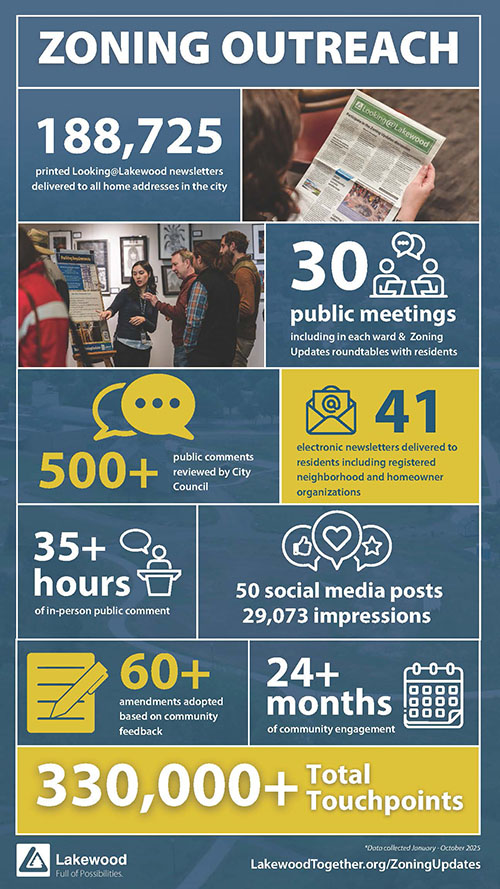
Check out the snapshot below of how Lakewood kept residents informed and involved in the Zoning Updates process. We connected with the community most directly by providing information through front page articles in Looking@Lakewood, the city's printed newsletter mailed to all addresses in the city, which means all households received this in their mail:
- March edition: Help envision Lakewood's future
- May edition: Participate in Zoning Updates discussion, which outlines the proposed changes.
Accessible version of snapshot
Learn what the Zoning Updates mean for your with this video.
We've added a new map that showsContinue reading
Zoning information provided to residents
Check out the snapshot below of how Lakewood kept residents informed and involved in the Zoning Updates process. We connected with the community most directly by providing information through front page articles in Looking@Lakewood, the city's printed newsletter mailed to all addresses in the city, which means all households received this in their mail:
- March edition: Help envision Lakewood's future
- May edition: Participate in Zoning Updates discussion, which outlines the proposed changes.
Accessible version of snapshot
Learn what the Zoning Updates mean for your with this video.
We've added a new map that shows both the current and proposed residential zoning districts. To understand the legend on the map, use the Legend for Current Residential Districts and the Legend for Zoning Map for the proposed districts.
The proposed Zoning Updates involve complex and detailed information because they are land-use regulations, and we've added answers to frequently asked questions, where you can learn more through detailed answers.
It's also important to know that not all properties will experience changes under the proposed updates even though the zoning code affects every property. To help residents with these complex regulatory proposals, we are adding to the numerous resources that have been available on this page:
- A map legend to understand the zoning district abbreviations on the zoning maps.
- A Table of Contents that outlines the specific topics covered by each article in the Zoning Ordinance.
- Redline version of the proposed changes in Spanish. This is available along with a redline version in English and the zoning code as it is currently -- all on one city webpage.
- New maps, one with the full city and four quadrant maps, that show the transit corridors through Lakewood.
Additional resources that can help you understand the proposals:
- Q&A for Zoning Updates or the Looking@Lakewood article from May.
- Video presentation about the updates.
- Staff memo outlining the work that has been done by City Council and the Planning Commission during the last few months.
- City Council's 2024 resolution about its priorities.
Other additions to the page posted this week:
- Quadrant Map to allow residents to see individual street names and better identify the proposed zoning for properties by breaking up the map of the city into four individual quadrants.
New public hearing schedule
- Aug. 25 for Articles 6-14 of the proposed zoning code.
- Sept. 8 for Articles 1, 2, 4 and 5.
- Sept. 22 for Article 3.
- Oct. 13 for the zoning map.
As a refresher, the Zoning Updates are changes proposed to regulations that execute the community's vision set in the Comprehensive Plan, which is an advisory document that informs decisions about housing, transportation, sustainability, parks and more for the next 15 years. The zoning changes are a major component of implementing the Comprehensive Plan and promoting its goals.
Why are zoning updates important?
Zoning is a set of laws that regulate how land can be used in a specific area, and cities create these regulations to promote the health and safety of the community. Over the years, these zoning laws need to be updated, and Lakewood is in the process of updating its Zoning Ordinance.
The proposed changes that the Planning Commission and City Council will discuss in the coming months cover three main areas outlined below. Visit the News feed to learn about these different areas of updates:
- Technical changes that clean up, clarify and modernize the zoning regulations.
- City Council requested changes that will address housing needs.
- Modifications required under new state laws.
Follow this discussion and stay up to date on this work:
- Watch a presentation about these updates.
- Review the Q&A for Zoning Updates or the Looking@Lakewood article.
- Check the News feed to learn more.
- Read the Zoning Update Staff Report.
- Review the City Council's 2024 resolution about its priorities.
- Review the timeline for upcoming meetings and public hearings to find out when to participate in the discussion.
- Sign up to follow the project.
Consultation has concluded.
Ask your question here, and city staff will respond within three business days. Questions and answers about this project can be visible to the public.
For general questions and concerns about the city, please visit Lakewood.org/RequestLakewood, which is the city's online customer service hub available 24 hours a day.
-
Share I live in Greenbriar Cloverdale. Would appreciate a picture of the zoning map as it is and a 2nd picture of the zoning map if this rezoning passes. on Facebook Share I live in Greenbriar Cloverdale. Would appreciate a picture of the zoning map as it is and a 2nd picture of the zoning map if this rezoning passes. on X (formerly Twitter) Share I live in Greenbriar Cloverdale. Would appreciate a picture of the zoning map as it is and a 2nd picture of the zoning map if this rezoning passes. on Linkedin Email I live in Greenbriar Cloverdale. Would appreciate a picture of the zoning map as it is and a 2nd picture of the zoning map if this rezoning passes. link
I live in Greenbriar Cloverdale. Would appreciate a picture of the zoning map as it is and a 2nd picture of the zoning map if this rezoning passes.
Leila asked 6 months agoA map with the comparison of the zoning "as it is" with the zoning updates is available on the project page in the document labeled "Map with the current and proposed residential zoning."
-
Share Please update this page: https://www.lakewoodtogether.org/zoningupdates/news_feed/more-resources-to-help-you It indicates that redlines may be found at this page: https://www.lakewoodco.gov/City-Hall/Departments/Sustainability-and-Community-Development/Lakewood-Zoning-Ordinance These documents are not redlines. The only redline I can find is here: NEW Proposed Zoning Code - July 2025 final redlines (6.53 MB) (pdf) I found this by doing a search operation (CTRL+F) on the very page where I'm submitting this request. on Facebook Share Please update this page: https://www.lakewoodtogether.org/zoningupdates/news_feed/more-resources-to-help-you It indicates that redlines may be found at this page: https://www.lakewoodco.gov/City-Hall/Departments/Sustainability-and-Community-Development/Lakewood-Zoning-Ordinance These documents are not redlines. The only redline I can find is here: NEW Proposed Zoning Code - July 2025 final redlines (6.53 MB) (pdf) I found this by doing a search operation (CTRL+F) on the very page where I'm submitting this request. on X (formerly Twitter) Share Please update this page: https://www.lakewoodtogether.org/zoningupdates/news_feed/more-resources-to-help-you It indicates that redlines may be found at this page: https://www.lakewoodco.gov/City-Hall/Departments/Sustainability-and-Community-Development/Lakewood-Zoning-Ordinance These documents are not redlines. The only redline I can find is here: NEW Proposed Zoning Code - July 2025 final redlines (6.53 MB) (pdf) I found this by doing a search operation (CTRL+F) on the very page where I'm submitting this request. on Linkedin Email Please update this page: https://www.lakewoodtogether.org/zoningupdates/news_feed/more-resources-to-help-you It indicates that redlines may be found at this page: https://www.lakewoodco.gov/City-Hall/Departments/Sustainability-and-Community-Development/Lakewood-Zoning-Ordinance These documents are not redlines. The only redline I can find is here: NEW Proposed Zoning Code - July 2025 final redlines (6.53 MB) (pdf) I found this by doing a search operation (CTRL+F) on the very page where I'm submitting this request. link
Please update this page: https://www.lakewoodtogether.org/zoningupdates/news_feed/more-resources-to-help-you It indicates that redlines may be found at this page: https://www.lakewoodco.gov/City-Hall/Departments/Sustainability-and-Community-Development/Lakewood-Zoning-Ordinance These documents are not redlines. The only redline I can find is here: NEW Proposed Zoning Code - July 2025 final redlines (6.53 MB) (pdf) I found this by doing a search operation (CTRL+F) on the very page where I'm submitting this request.
heather.revanna asked 7 months agoHeather -- Because this project has concluded, this page won't continue to be updated, and the newsfeed from Aug. 15 would only be current for the date it was posted. The July 2025 redlines will not include amendments the City Council made during the public hearings. The Lakewood Zoning Ordinance page does provide the comparison between what City Council approved and the previous zoning code. You could contact the Planner of the Day to ask for copies of the the redline that includes the City Council amendments/final version of the updates.
-- The Project Team
-
Share I understand that the new zoning code that is on the ballot allows for more housing types (duplex, triplex, ADU, etc), but also requires the entire square footage to be under 5,000 SF and comply with open space requirements on lots, setbacks, heights. What I don't understand is where this type of flexibility for housing options is allowed. Will all residential neighborhoods allow this flexibility, granted the new developments meet open space, setbacks, gross SF requirements? Additionally, I understand that basements are not included in the 5,000-SF max. Would the new zoning code allow for English basement type dwellings? For what it's worth, I live in Lakewood and my home is zoned Large Lot Residential. I want to see if the new codes would allow for this flexibility in my neighborhood. Also, thank you for making this service available! on Facebook Share I understand that the new zoning code that is on the ballot allows for more housing types (duplex, triplex, ADU, etc), but also requires the entire square footage to be under 5,000 SF and comply with open space requirements on lots, setbacks, heights. What I don't understand is where this type of flexibility for housing options is allowed. Will all residential neighborhoods allow this flexibility, granted the new developments meet open space, setbacks, gross SF requirements? Additionally, I understand that basements are not included in the 5,000-SF max. Would the new zoning code allow for English basement type dwellings? For what it's worth, I live in Lakewood and my home is zoned Large Lot Residential. I want to see if the new codes would allow for this flexibility in my neighborhood. Also, thank you for making this service available! on X (formerly Twitter) Share I understand that the new zoning code that is on the ballot allows for more housing types (duplex, triplex, ADU, etc), but also requires the entire square footage to be under 5,000 SF and comply with open space requirements on lots, setbacks, heights. What I don't understand is where this type of flexibility for housing options is allowed. Will all residential neighborhoods allow this flexibility, granted the new developments meet open space, setbacks, gross SF requirements? Additionally, I understand that basements are not included in the 5,000-SF max. Would the new zoning code allow for English basement type dwellings? For what it's worth, I live in Lakewood and my home is zoned Large Lot Residential. I want to see if the new codes would allow for this flexibility in my neighborhood. Also, thank you for making this service available! on Linkedin Email I understand that the new zoning code that is on the ballot allows for more housing types (duplex, triplex, ADU, etc), but also requires the entire square footage to be under 5,000 SF and comply with open space requirements on lots, setbacks, heights. What I don't understand is where this type of flexibility for housing options is allowed. Will all residential neighborhoods allow this flexibility, granted the new developments meet open space, setbacks, gross SF requirements? Additionally, I understand that basements are not included in the 5,000-SF max. Would the new zoning code allow for English basement type dwellings? For what it's worth, I live in Lakewood and my home is zoned Large Lot Residential. I want to see if the new codes would allow for this flexibility in my neighborhood. Also, thank you for making this service available! link
I understand that the new zoning code that is on the ballot allows for more housing types (duplex, triplex, ADU, etc), but also requires the entire square footage to be under 5,000 SF and comply with open space requirements on lots, setbacks, heights. What I don't understand is where this type of flexibility for housing options is allowed. Will all residential neighborhoods allow this flexibility, granted the new developments meet open space, setbacks, gross SF requirements? Additionally, I understand that basements are not included in the 5,000-SF max. Would the new zoning code allow for English basement type dwellings? For what it's worth, I live in Lakewood and my home is zoned Large Lot Residential. I want to see if the new codes would allow for this flexibility in my neighborhood. Also, thank you for making this service available!
mryan1191 asked 7 months agoThe referenced flexible housing options will be allowed in three of the Low-form Residential Zone Districts: R-L-A, R-L-B and R-L-C.
Residential neighborhoods located within one of the new low-form residential zone districts would have this flexibility through the zoning code; however, please be aware that other private covenants/restrictions may be in place that might be more restrictive than the zoning regulations enforced by the city.
The term “English Basement” is not one that the planning staff is familiar with. If you would like to explore a specific improvement to your property, please reach out to the Planner of the Day at POD@lakewoodco.gov to discuss any zoning related questions.
-- The Project Team
-
Share My house is on a 12580 square feet lot, and I have been wanting to build an ADU in my backyard for a long time. However, this desire has been deterred by the restriction of total accessory building area no more than 10% of property. Even though I have over 10000 square feet “spare” area on my property besides the primary house plus a detached garage and a shed, I will only be allowed to build an ADU with maximum 600 square feet according to above restriction. Looking at the new zoning map, I could build three primary houses on this property, but can’t build a decent sized ADU! I don’t quite understand this rationale. I had made a comment about this concern last August through Lakewood Speaks, but disappointedly to see that no change on this policy! on Facebook Share My house is on a 12580 square feet lot, and I have been wanting to build an ADU in my backyard for a long time. However, this desire has been deterred by the restriction of total accessory building area no more than 10% of property. Even though I have over 10000 square feet “spare” area on my property besides the primary house plus a detached garage and a shed, I will only be allowed to build an ADU with maximum 600 square feet according to above restriction. Looking at the new zoning map, I could build three primary houses on this property, but can’t build a decent sized ADU! I don’t quite understand this rationale. I had made a comment about this concern last August through Lakewood Speaks, but disappointedly to see that no change on this policy! on X (formerly Twitter) Share My house is on a 12580 square feet lot, and I have been wanting to build an ADU in my backyard for a long time. However, this desire has been deterred by the restriction of total accessory building area no more than 10% of property. Even though I have over 10000 square feet “spare” area on my property besides the primary house plus a detached garage and a shed, I will only be allowed to build an ADU with maximum 600 square feet according to above restriction. Looking at the new zoning map, I could build three primary houses on this property, but can’t build a decent sized ADU! I don’t quite understand this rationale. I had made a comment about this concern last August through Lakewood Speaks, but disappointedly to see that no change on this policy! on Linkedin Email My house is on a 12580 square feet lot, and I have been wanting to build an ADU in my backyard for a long time. However, this desire has been deterred by the restriction of total accessory building area no more than 10% of property. Even though I have over 10000 square feet “spare” area on my property besides the primary house plus a detached garage and a shed, I will only be allowed to build an ADU with maximum 600 square feet according to above restriction. Looking at the new zoning map, I could build three primary houses on this property, but can’t build a decent sized ADU! I don’t quite understand this rationale. I had made a comment about this concern last August through Lakewood Speaks, but disappointedly to see that no change on this policy! link
My house is on a 12580 square feet lot, and I have been wanting to build an ADU in my backyard for a long time. However, this desire has been deterred by the restriction of total accessory building area no more than 10% of property. Even though I have over 10000 square feet “spare” area on my property besides the primary house plus a detached garage and a shed, I will only be allowed to build an ADU with maximum 600 square feet according to above restriction. Looking at the new zoning map, I could build three primary houses on this property, but can’t build a decent sized ADU! I don’t quite understand this rationale. I had made a comment about this concern last August through Lakewood Speaks, but disappointedly to see that no change on this policy!
Joy asked 7 months agoThank you for providing this feedback. Each property is unique when it comes to the size of a new Accessory Dwelling Unit (ADU) that can be accommodated on a existing lot. While the maximum size of a detached ADU is capped at 1,400 square feet, some properties may not be able to accommodate an ADU at the maximum size that is permitted by the zoning ordinance. There are additional dimensional standards found in Section 17.5.5.1 of the zoning ordinance that apply to all detached accessory structures including ADU’s. At a minimum, the allowable size for a new accessory dwelling on your property will be informed by the following items:
- Gross floor area (GFA) of the existing (or proposed) primary structure
- Area of all combined accessory structures (including the proposed ADU)
- Minimum required open space
- Size/configuration of an individual lot
- Combined area of the side and rear yards
Lakewood’s Development Review planning team is available to discuss options that may help you to maximize the allowable size of the ADU within the adopted supplemental and dimensional standards that apply.If you would like to explore other possible options to add a second unit on your property, please contact Laura McKibbin via email at laura.mckibbin@lakewoodco.gov or 303-987-7946.
-
Share I live in applewood and the new zoning designation allows for SF with the possibilitiy of ADUs and duplexes (that fit the character of the neighborhood). My question is -- if the size limit is 5000 SF per dwelling unit, would that allow a 10,000 sf townhouse in my neighborhood (because a townhouse is 2 dwelling units) on Facebook Share I live in applewood and the new zoning designation allows for SF with the possibilitiy of ADUs and duplexes (that fit the character of the neighborhood). My question is -- if the size limit is 5000 SF per dwelling unit, would that allow a 10,000 sf townhouse in my neighborhood (because a townhouse is 2 dwelling units) on X (formerly Twitter) Share I live in applewood and the new zoning designation allows for SF with the possibilitiy of ADUs and duplexes (that fit the character of the neighborhood). My question is -- if the size limit is 5000 SF per dwelling unit, would that allow a 10,000 sf townhouse in my neighborhood (because a townhouse is 2 dwelling units) on Linkedin Email I live in applewood and the new zoning designation allows for SF with the possibilitiy of ADUs and duplexes (that fit the character of the neighborhood). My question is -- if the size limit is 5000 SF per dwelling unit, would that allow a 10,000 sf townhouse in my neighborhood (because a townhouse is 2 dwelling units) link
I live in applewood and the new zoning designation allows for SF with the possibilitiy of ADUs and duplexes (that fit the character of the neighborhood). My question is -- if the size limit is 5000 SF per dwelling unit, would that allow a 10,000 sf townhouse in my neighborhood (because a townhouse is 2 dwelling units)
nancy C asked 7 months agoNancy -- Here is information regarding your question.
The short answer to this question is no, you could not have a primary structure that included two dwelling units above the 4,000 gross floor area (GFA) size cap. A primary structure that exceeds 4,000 GFA (with a max of two units) or 5,000 GFA (with three or more units) is not permitted in the R-L-B zone district.
In addition to the primary structure size limits, each R-L lot would still need to respect minimum setbacks and provide the minimum percentage of open space required in the zone district. The primary structure would also be limited to a maximum height of 35 feet. So, depending on the lot size, it may not be possible to construct a 4,000 or 5,000 GFA structure on every lot in the Applewood neighborhood.
The following information provides a bit more detail of how primary structure size caps would work:
In the R-L-B zone district, there is a maximum primary structure size, which is not to be confused or interchanged with the gross floor area (GFA) of individual units within the primary structure.
- For R-L-B lots with one primary structure, the total structure size is limited to 4,000 GFA for a primary structure that has 1-2 dwelling units within it. This means that the combined size of both units within the primary structure cannot exceed 4,000 GFA. Only one primary structure at 4,000 GFA would be allowed on a single R-L-B lot.
- For R-L-B lots that have one primary structure with 3 or more units, the cap or maximum structure size is 5,000 square feet. A Special Use Permit (approved by the Planning Commission) would be required for a primary structure of 5,000 square feet that included more than three dwelling units. The combined size of all three (or more) units within the one primary structure could not exceed 5,000 GFA.
-- The Project Team
-
Share THE NEW ZONING LAWS NEED TO BE TAKEN TO A PUBLIC VOTE. SHAME ON YOU. WHY DID YOU NOT MAKE THIS PUBLIC A LONG TIME AGO ? on Facebook Share THE NEW ZONING LAWS NEED TO BE TAKEN TO A PUBLIC VOTE. SHAME ON YOU. WHY DID YOU NOT MAKE THIS PUBLIC A LONG TIME AGO ? on X (formerly Twitter) Share THE NEW ZONING LAWS NEED TO BE TAKEN TO A PUBLIC VOTE. SHAME ON YOU. WHY DID YOU NOT MAKE THIS PUBLIC A LONG TIME AGO ? on Linkedin Email THE NEW ZONING LAWS NEED TO BE TAKEN TO A PUBLIC VOTE. SHAME ON YOU. WHY DID YOU NOT MAKE THIS PUBLIC A LONG TIME AGO ? link
THE NEW ZONING LAWS NEED TO BE TAKEN TO A PUBLIC VOTE. SHAME ON YOU. WHY DID YOU NOT MAKE THIS PUBLIC A LONG TIME AGO ?
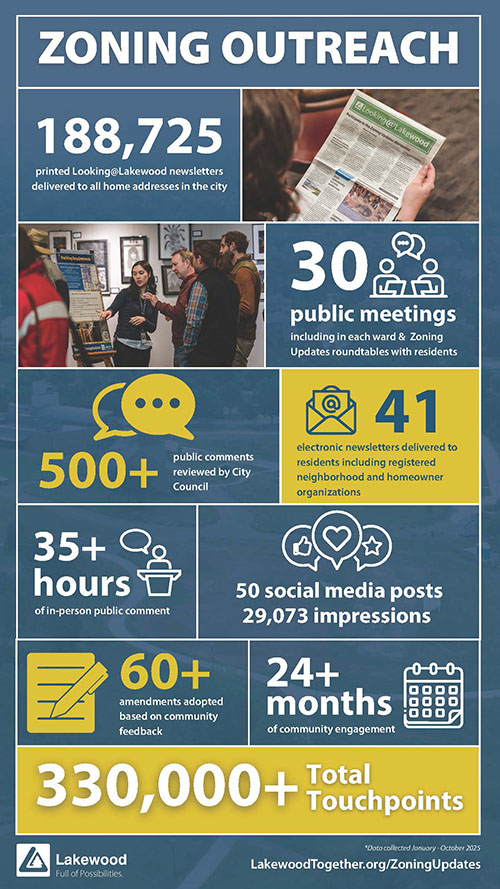
asked 12 months agoThanks for your interest in this project. We launched this project page on Feb. 14, 2025, and we connected with the community most directly by providing information through front page articles in Looking@Lakewood, the city's printed newsletter mailed to all addresses in the city, which means all households received this in their mail:
- March edition: Help envision Lakewood's future
- May edition: Participate in Zoning Updates discussion, which outlines the proposed changes.
Please also review this snapshot of all the ways residents were contacted and involved in shaping this process:
Kind regards,
The Project Team
-
Share How would a neighborhood request a different zoning designation than is on the proposed map? on Facebook Share How would a neighborhood request a different zoning designation than is on the proposed map? on X (formerly Twitter) Share How would a neighborhood request a different zoning designation than is on the proposed map? on Linkedin Email How would a neighborhood request a different zoning designation than is on the proposed map? link
How would a neighborhood request a different zoning designation than is on the proposed map?
lkmajors asked about 1 year agoThanks for your interest in this project. Any individual or group of property owners can always request rezoning of their own properties. For a neighborhood to request a broader rezoning, they would need to provide evidence of broad support (i.e. a petition or collection of individual requests) and meet with city planning staff about the process to rezone an area. In either case, a meeting with City Council representatives would be recommended.
Sincerely,
The Project Team
-
Share In 1975, I acquired my Green Mountain residence due to the zoning designation for single-family dwellings, which I anticipated would endure. However, Lakewood is proposing a rezoning that would transform my property into a multi-family zoning. 1. Kindly elaborate on the specific grounds from which Lakewood asserts its authority to significantly alter zoning from single-family to multi-family. 2. Furthermore, has there been a substantial transformation of the neighborhood’s character that necessitates a rezoning for the public good? 3. Please provide a comprehensive explanation of the tangible benefits that would accrue to the public interest as a result of this rezoning. on Facebook Share In 1975, I acquired my Green Mountain residence due to the zoning designation for single-family dwellings, which I anticipated would endure. However, Lakewood is proposing a rezoning that would transform my property into a multi-family zoning. 1. Kindly elaborate on the specific grounds from which Lakewood asserts its authority to significantly alter zoning from single-family to multi-family. 2. Furthermore, has there been a substantial transformation of the neighborhood’s character that necessitates a rezoning for the public good? 3. Please provide a comprehensive explanation of the tangible benefits that would accrue to the public interest as a result of this rezoning. on X (formerly Twitter) Share In 1975, I acquired my Green Mountain residence due to the zoning designation for single-family dwellings, which I anticipated would endure. However, Lakewood is proposing a rezoning that would transform my property into a multi-family zoning. 1. Kindly elaborate on the specific grounds from which Lakewood asserts its authority to significantly alter zoning from single-family to multi-family. 2. Furthermore, has there been a substantial transformation of the neighborhood’s character that necessitates a rezoning for the public good? 3. Please provide a comprehensive explanation of the tangible benefits that would accrue to the public interest as a result of this rezoning. on Linkedin Email In 1975, I acquired my Green Mountain residence due to the zoning designation for single-family dwellings, which I anticipated would endure. However, Lakewood is proposing a rezoning that would transform my property into a multi-family zoning. 1. Kindly elaborate on the specific grounds from which Lakewood asserts its authority to significantly alter zoning from single-family to multi-family. 2. Furthermore, has there been a substantial transformation of the neighborhood’s character that necessitates a rezoning for the public good? 3. Please provide a comprehensive explanation of the tangible benefits that would accrue to the public interest as a result of this rezoning. link
In 1975, I acquired my Green Mountain residence due to the zoning designation for single-family dwellings, which I anticipated would endure. However, Lakewood is proposing a rezoning that would transform my property into a multi-family zoning. 1. Kindly elaborate on the specific grounds from which Lakewood asserts its authority to significantly alter zoning from single-family to multi-family. 2. Furthermore, has there been a substantial transformation of the neighborhood’s character that necessitates a rezoning for the public good? 3. Please provide a comprehensive explanation of the tangible benefits that would accrue to the public interest as a result of this rezoning.
JohnM asked about 1 year agoJohn -- Thanks for your patience as we put together this information for you.
The zoning designation on your home has already changed a number of times since 1975, and, as with those changes, the proposed updates changes nothing with your ability to live in it, sell it, or pass it on.
1. Kindly elaborate on the specific grounds from which Lakewood asserts its authority to significantly alter zoning from single-family to multi-family.
According to the Lakewood city charter, Article 9.1(d): “For the purpose of promoting the health, safety, and general welfare of the City, the City Council shall provide for zoning regulations and restrictions within the City by ordinance.”
2. Furthermore, has there been a substantial transformation of the neighborhood’s character that necessitates a rezoning for the public good?
The proposed changes are an effort to protect neighborhoods from the impact of new state laws. It will limit the size of new homes built in the future by making them match in size with the current homes while also addressing the need for new affordable housing.
To understand why these changes are proposed, it’s important to understand how the city’s current zoning regulations and a new state law intersect and what potential impacts could result from that if the city takes no action.
- Currently, Lakewood’s zoning regulations allow homes as large as 10,000-18,000 square feet, with up to three stories, to be built in residential areas. For context, houses most commonly found in Lakewood are about 1,200-1,500 square feet in single story, so a 10,000-18,000-square-foot house would be 8 to 14 times larger and two times taller at 35 feet high.
- A new state law, HB24-1007, prevents cities from regulating the number of people living in a house. As a result, it abolishes Lakewood’s current zoning regulation that limits to five the number of people living in a home.
- The 10,000-18,000-square-foot homes allowed under the city’s current regulations haven’t been built because there has been no demand for that size of house for one family.
- Under the new state law, however, those massive homes could be built, and they could be occupied by dozens of residents, potentially containing numerous individually rented bedrooms within the building.
- These massive homes, with numerous residents living in them, would create significant changes in Lakewood’s neighborhoods.
- To ensure that houses in the future are comparable with the existing homes in Lakewood neighborhoods, the Zoning Updates propose to combine the current eight residential zone districts into five and then limit the size of homes within each of those districts. Additionally, homes would be limited to 35 feet in all the districts but one:
- Low-Form Residential (R-L-A, R-L-B & R-L-C): Home size limited to 4,000 square feet for one or two units, 5,000 square feet for three or more units.
- Mobile Home District: Home size for mobile homes.
- Mid-Form Residential: Multifamily structures allowed up to 45 feet high.
- These changes will significantly limit large multifamily buildings while also accommodating a large single-family home of 2,500 square feet or more.
- The new districts, however, would no longer limit the number of units built within the square footage because of the new state law. As a result, more duplexes, town homes and affordable options could be built to foster housing affordability.
3. Please provide a comprehensive explanation of the tangible benefits that would accrue to the public interest as a result of this rezoning.
Zoning updates aren’t about dramatic changes overnight. It’s about balancing the need to protect the existing neighborhoods while planning responsibly for the future. It protects the character of neighborhoods and also creates more housing options for our kids, parents, teachers, firefighters and police agents to be able to afford to live here.
John -- Thanks for your interest in this project and contacting us. We are working on answering your questions, but staff has been tied up this week. We will respond to these next week.
Sincerely,
The Project Team
-
Share Lakewood, a Home Rule City, retains the authority to govern local land use and zoning. However, Lakewood has opted to relinquish its Home Rule right to zoning control and conform to the newly enacted Colorado zoning statutes. Kindly provide the following information regarding this decision: 1. The individual or entity responsible for making the decision to waive Lakewood’s right to exercise local control over zoning. 2. The date on which this decision was taken. 3. The methods and channels through which citizens were informed of Lakewood’s decision to transition from local zoning control to Colorado statutory control. 4. The procedures and opportunities provided for citizens to participate in public hearings regarding this shift from local control to Colorado statutory control. Seven Home Rule Cities contend that Colorado has exceeded its authority and have filed a lawsuit against Colorado in the Denver District Court to challenge the constitutionality of the new zoning statutes. 1. Why did Lakewood choose to align with the new Colorado zoning statutes rather than safeguarding its Home Rule rights to exercise local control over zoning? 2. Why is Lakewood proceeding with zoning modifications that may be deemed unconstitutional, particularly considering that Colorado’s courts have consistently recognized land use and zoning as fundamental concerns of local governance? on Facebook Share Lakewood, a Home Rule City, retains the authority to govern local land use and zoning. However, Lakewood has opted to relinquish its Home Rule right to zoning control and conform to the newly enacted Colorado zoning statutes. Kindly provide the following information regarding this decision: 1. The individual or entity responsible for making the decision to waive Lakewood’s right to exercise local control over zoning. 2. The date on which this decision was taken. 3. The methods and channels through which citizens were informed of Lakewood’s decision to transition from local zoning control to Colorado statutory control. 4. The procedures and opportunities provided for citizens to participate in public hearings regarding this shift from local control to Colorado statutory control. Seven Home Rule Cities contend that Colorado has exceeded its authority and have filed a lawsuit against Colorado in the Denver District Court to challenge the constitutionality of the new zoning statutes. 1. Why did Lakewood choose to align with the new Colorado zoning statutes rather than safeguarding its Home Rule rights to exercise local control over zoning? 2. Why is Lakewood proceeding with zoning modifications that may be deemed unconstitutional, particularly considering that Colorado’s courts have consistently recognized land use and zoning as fundamental concerns of local governance? on X (formerly Twitter) Share Lakewood, a Home Rule City, retains the authority to govern local land use and zoning. However, Lakewood has opted to relinquish its Home Rule right to zoning control and conform to the newly enacted Colorado zoning statutes. Kindly provide the following information regarding this decision: 1. The individual or entity responsible for making the decision to waive Lakewood’s right to exercise local control over zoning. 2. The date on which this decision was taken. 3. The methods and channels through which citizens were informed of Lakewood’s decision to transition from local zoning control to Colorado statutory control. 4. The procedures and opportunities provided for citizens to participate in public hearings regarding this shift from local control to Colorado statutory control. Seven Home Rule Cities contend that Colorado has exceeded its authority and have filed a lawsuit against Colorado in the Denver District Court to challenge the constitutionality of the new zoning statutes. 1. Why did Lakewood choose to align with the new Colorado zoning statutes rather than safeguarding its Home Rule rights to exercise local control over zoning? 2. Why is Lakewood proceeding with zoning modifications that may be deemed unconstitutional, particularly considering that Colorado’s courts have consistently recognized land use and zoning as fundamental concerns of local governance? on Linkedin Email Lakewood, a Home Rule City, retains the authority to govern local land use and zoning. However, Lakewood has opted to relinquish its Home Rule right to zoning control and conform to the newly enacted Colorado zoning statutes. Kindly provide the following information regarding this decision: 1. The individual or entity responsible for making the decision to waive Lakewood’s right to exercise local control over zoning. 2. The date on which this decision was taken. 3. The methods and channels through which citizens were informed of Lakewood’s decision to transition from local zoning control to Colorado statutory control. 4. The procedures and opportunities provided for citizens to participate in public hearings regarding this shift from local control to Colorado statutory control. Seven Home Rule Cities contend that Colorado has exceeded its authority and have filed a lawsuit against Colorado in the Denver District Court to challenge the constitutionality of the new zoning statutes. 1. Why did Lakewood choose to align with the new Colorado zoning statutes rather than safeguarding its Home Rule rights to exercise local control over zoning? 2. Why is Lakewood proceeding with zoning modifications that may be deemed unconstitutional, particularly considering that Colorado’s courts have consistently recognized land use and zoning as fundamental concerns of local governance? link
Lakewood, a Home Rule City, retains the authority to govern local land use and zoning. However, Lakewood has opted to relinquish its Home Rule right to zoning control and conform to the newly enacted Colorado zoning statutes. Kindly provide the following information regarding this decision: 1. The individual or entity responsible for making the decision to waive Lakewood’s right to exercise local control over zoning. 2. The date on which this decision was taken. 3. The methods and channels through which citizens were informed of Lakewood’s decision to transition from local zoning control to Colorado statutory control. 4. The procedures and opportunities provided for citizens to participate in public hearings regarding this shift from local control to Colorado statutory control. Seven Home Rule Cities contend that Colorado has exceeded its authority and have filed a lawsuit against Colorado in the Denver District Court to challenge the constitutionality of the new zoning statutes. 1. Why did Lakewood choose to align with the new Colorado zoning statutes rather than safeguarding its Home Rule rights to exercise local control over zoning? 2. Why is Lakewood proceeding with zoning modifications that may be deemed unconstitutional, particularly considering that Colorado’s courts have consistently recognized land use and zoning as fundamental concerns of local governance?
JohnM asked about 1 year agoThank you for your question. To clarify, Lakewood has not waived its Home Rule authority over zoning. As a Home Rule city, Lakewood continues to make its own land use and zoning decisions. That said, there are some parts of the proposed zoning code update that align with new state laws, but these changes are being considered because City Council directed staff to create a zoning ordinance that best serves Lakewood’s needs while also reflecting state requirements.
There has not been a decision to “transition” to state control. The zoning code update is a local process, with multiple opportunities for public input through hearings, study sessions, and engagement platforms like LakewoodSpeaks.org.
On your question about the lawsuit filed by other cities: Lakewood’s City Council has chosen to move forward with the zoning code update in the way it believes is most appropriate for our community. If a court ultimately determines that any portion of state law is unconstitutional, Lakewood will make any adjustments needed to ensure our code complies with the law.
Sincerely,
The Project Team
-
Share Hello! Where can I find PDF documents that show the changes or the new amendments for the subdivision ordinance? on Facebook Share Hello! Where can I find PDF documents that show the changes or the new amendments for the subdivision ordinance? on X (formerly Twitter) Share Hello! Where can I find PDF documents that show the changes or the new amendments for the subdivision ordinance? on Linkedin Email Hello! Where can I find PDF documents that show the changes or the new amendments for the subdivision ordinance? link
Hello! Where can I find PDF documents that show the changes or the new amendments for the subdivision ordinance?
CDR asked over 1 year agoThanks for your interest in this project, and the updated documents with the new amendments are expected to take a couple more weeks. They will be posted as soon as they are available.
Best regards,
The Project Team
-
 Click here to play video
Zoning Updates
Mayor Wendi Strom covers questions that have come up in the community about the Zoning Updates.
Click here to play video
Zoning Updates
Mayor Wendi Strom covers questions that have come up in the community about the Zoning Updates.
The updated zoning code will go into effect on Jan. 1, 2026. Use the links below to review the new zoning code and map that City Council approved.
If you need an accessible version of any documents on this project page, please contact adacoordinator@lakewood.org(External link).
-
 Zoning Ordinance _ Approved for 1-1-2026.pdf (7.02 MB) (pdf)
-
 Maps
Maps
-
Zoning Ordinance webpage
-
Table of contents for zoning code (195 KB) (pdf)
-
City Council resolution on its values and top policy priorities.
-
20251017 - Zoning Touchpoints Vertical Accessible (1).pdf (4.65 MB) (pdf)
-
Zoning Updates touchpoints June 2-Aug. 11_2025 (80.5 KB) (pdf)
-
Zoning Updates touchpoints_February_to_June_2025 (110 KB) (pdf)
-
Past documents
-
Legend for Current Residential Districts.pdf (55.8 KB) (pdf)
-
QA Zoning Updates.pdf (126 KB) (pdf)
-
Map with current and proposed residential zoning.pdf (1.42 MB) (pdf)
-
NEW Draft Zoning Map (July 14 2025) (1.63 MB) (pdf)
-
NEW Zoning Quadrant Maps 1-4 (5.02 MB) (pdf)
-
Transit Area Map (334 KB) (pdf)
-
Draft Zoning with Transit Areas Quadrant Maps 1-4 (5.04 MB) (pdf)
-
Redline version of proposed Zoning Amendments
-
NEW Staff Memo July_2025 Zoning Updates (190 KB) (pdf)
-
NEW Proposed Zoning Code - July 2025 final redlines (6.53 MB) (pdf)
-
Clean version of proposed Zoning Amendments
-
Residential - Proposed Map Amendments Draft Residential Zone Districts (336 KB) (pdf)
-
Nonresidential - Proposed Map Amendments (2.65 MB) (pdf)
-
April 9 Staff Memo_2025 Zoning Updates (40.7 KB) (docx)
-
April 23 presentation addressing comments (PowerPoint) (6.23 MB) (pptx)
-
Enhanced Development Menu Summary (101 KB) (pdf)
-
Planning Commission staff memo (141 KB) (pdf)
-
Zoning Update Open House Boards (68 MB) (pdf)
-
Zoning Update Staff Report.pdf (141 KB) (pdf)
-

-
Feb. 19 Planning Commission meeting
Zoning Updates has finished this stageCommission will discuss both the Comprehensive Plan Updates and Zoning Updates. Watch the presentations about these updates: Comprehensive Plan and Zoning Updates. To review the information in the agenda packet and to provide public comment, visit LakewoodSpeaks.org.
-
March 17 City Council study session
Zoning Updates has finished this stageCouncil will discuss both the Comprehensive Plan Update and the Zoning Updates. Information about this meeting will be posted 10 days prior to the meeting at LakewoodSpeaks.org
-
Zoning Updates April 3 open house
Zoning Updates has finished this stageCome learn about Zoning Updates and share your thoughts, 4-6 p.m. April 3 at the Lakewood Cultural Center, 470 S. Allison Parkway.
-
April 9 Planning Commission first public hearing
Zoning Updates has finished this stageThis is the first of three Planning Commission public hearings. This one will focus on the Comprehensive Plan Update to receive public testimony and make recommendations to City Council.
-
April 23 Planning Commission second public hearing
Zoning Updates has finished this stageThis is the second of three Planning Commission public hearings. It will include both the Comprehensive Plan Update and serve as the first public hearing on the Zoning Updates to receive public testimony and make recommendations to City Council.
-
May 21 Planning Commission hearing
Zoning Updates has finished this stageThis is the third of three Planning Commission public hearings. This will focus on the Zoning Updates to receive public testimony and make recommendations to City Council.
-
Upcoming City Council meetings
Zoning Updates has finished this stage- Aug. 25 -- Public hearing for Articles 6-14 of the proposed zoning code.
- Sept. 8 -- Public hearing for Articles 1, 2, 4 and 5.
- Sept. 22 -- Public hearing for Article 3.
- Oct. 13 -- Public hearing on zoning map.
-
Jan. 1, 2026 -- The new zoning code will go into effect starting with the new year.
Zoning Updates is currently at this stage

These touchpoints with residents for June 2-Aug. 11.

These touchpoints are items other than the contacts with residents during the April 3 open house and other public meetings that are part of this project.