
Defensible Space
According to the Colorado State Forest Service, "Defensible Space" refers to the area around a home or other structure that has been modified to reduce fire hazards. In this area, natural and manmade fuels are treated, cleared or reduced to slow the spread of wildfire. Defensible space reduces the likelihood of a structure igniting by direct contact with flame or by exposure to the radiant heat of a fire, and helps limit the production of embers that can spread the fire to neighboring homes and vegetation.
Creating defensible space involves establishing series of management zones around a building or other structure, also referred to as Home or Structure Ignition Zones (HIZ or SIZ).
The three defensible space zones are defined by their distance away from a structure:
- Zone 1 (0 to 5 feet): Immediate Zone
- The area nearest the home and other structures. It requires the most vigilant work to reduce wildfire hazards.
- Zone 2 (5 to 30 feet): Intermediate Zone
- The area transitioning away from the home, where fuels should be reduced to slow down an approaching fire.
- Zone 3 (30 to 100 feet): Expanded Zone
- The area farthest from the home. It extends to 100 feet from the home on relatively flat ground.
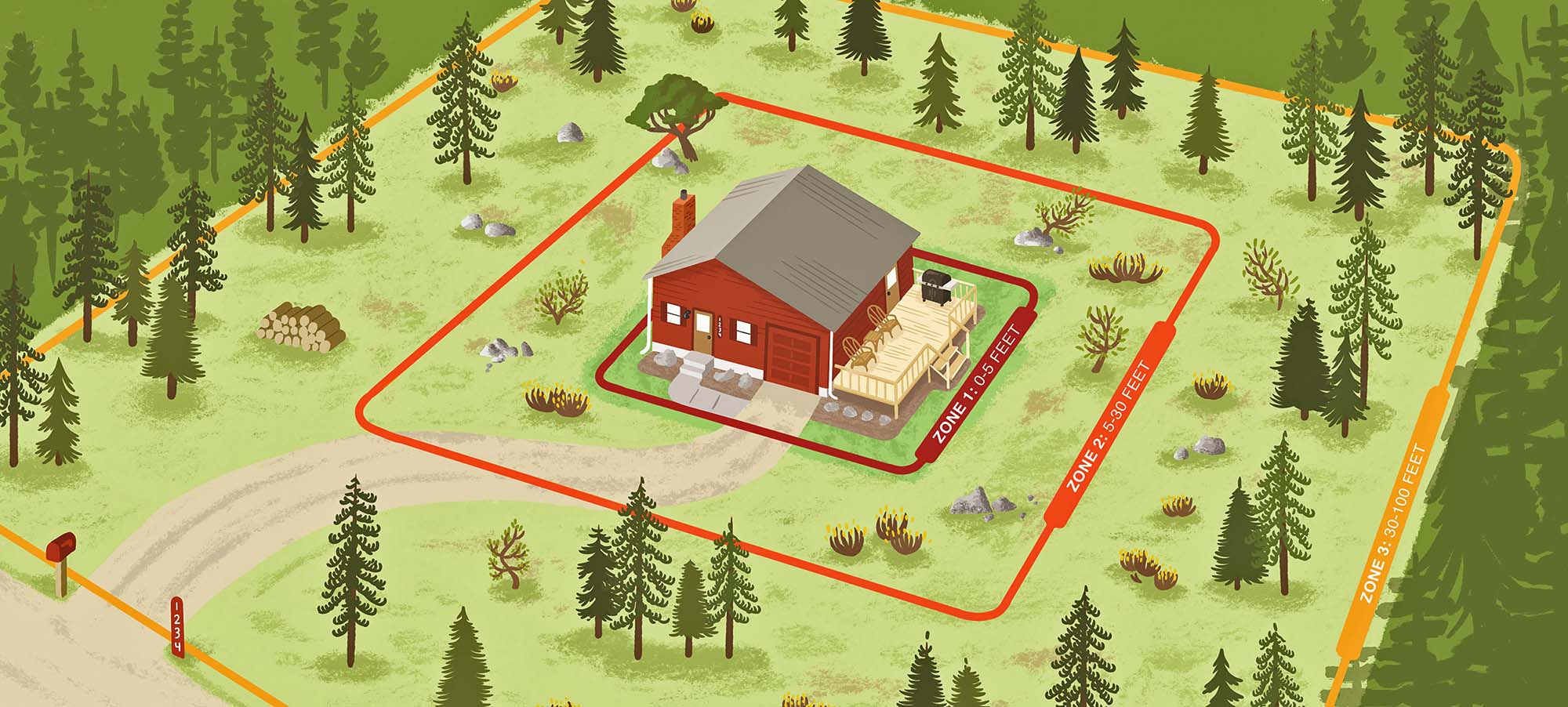
The Wildfire Resiliency Code includes standards for each defensible space zone depending on the fire intensity classification of the property, as defined on the Colorado Wildfire Resiliency Code Map. Class 1 refers to Low Intensity areas, while Class 2 refers to Medium and High Intensity areas. A summary of the Site and Area Requirements is listed below for reference. The full standards can be found in Chapter 5 of the Colorado Wildfire Resiliency Code.
- Zone 1 (0 to 5 feet): Immediate Zone, Class 1 and Class 2
- Designed to prevent ember ignition and direct flame contact with the structure, decks, stairs, and attachments.
- Use noncombustible hard surface materials, such as rock, gravel, concrete, or pavers.
- Remove plantings including shrubs, slash, combustible mulch and other woody debris, with the exception of ignition-resistant vegetation.
- No new trees planted, and prune branches of existing mature trees to provide at least 10 feet of clearance from the structure.
- Fences and retaining walls within 8 feet of a structure must be noncombustible or ignition-resistant materials.
- Zone 2 (5 to 30 feet): Intermediate Zone, Class 2 only
- Designed to reduce fire intensity near a structure by giving it less fuel.
- Remove dead plant materials such as leaves, logs, branches, slash, and combustible mulch.
- Prune tree branches to provide at least 10 feet of clearance from the structure.
- Space trees and shrubs to prevent fire spreading within the tree canopy.
- Zone 3 (30 to 100 feet): Expanded Zone, Class 2 only
- Intended to keep fire on the ground as it approaches a structure.
- Space tree crowns a minimum of 6 to 10 feet to prevent fire spreading within the tree canopy.
Consultation has concluded.
