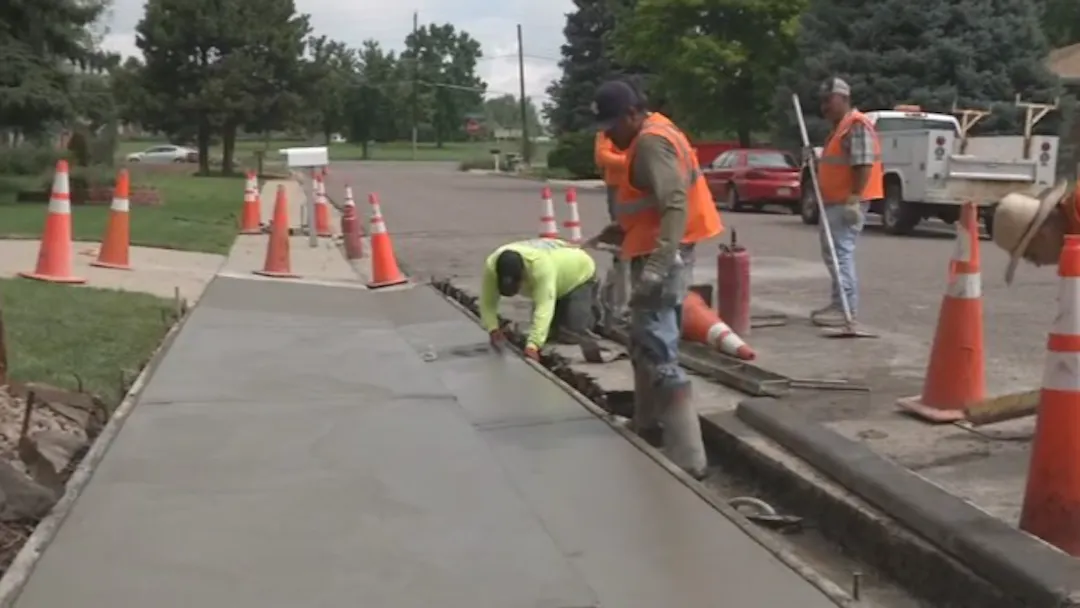
Share New sidewalks on FacebookShare New sidewalks on X (formerly Twitter)Share New sidewalks on LinkedinEmail New sidewalks link
Sidewalks are important for creating walkability, equity, access, mobility and protecting the environment and promoting health. Safe and accessible sidewalks serve students walking to school or the bus and enable individuals with disabilities, seniors, and those without access to vehicles to get where they need to go.
Lakewood was developed at a time when there wasn’t a lot of emphasis on building sidewalks. But the city has changed significantly since then, resulting in more people requesting sidewalks and shared-use paths for safety, recreation, and alternative means of transportation.
There are many locations in the city where sidewalks don’t existent, have “gaps” in continuity, or do not meet the established federal guidelines for accessibility. In 2020 and 2021, the Lakewood Advisory Commission developed a prioritization process for evaluating and prioritizing new sidewalk segments in places where they do not currently exist.
The goal of these efforts is to provide a safe pedestrian network that prioritizes the design and construction of critical segments and utilizes available funding judiciously.
Share Comprehensive Plan sidewalk goals on FacebookShare Comprehensive Plan sidewalk goals on X (formerly Twitter)Share Comprehensive Plan sidewalk goals on LinkedinEmail Comprehensive Plan sidewalk goals link
Lakewood’s Comprehensive Plan, Envision Lakewood 2040, strongly supports sidewalk construction as part of creating safe, connected, and equitable neighborhoods. Three key goals drive this direction:
Goal 17 advances “complete neighborhoods” where residents can meet daily needs nearby.
Goal 21 emphasizes a multi-modal system that serves all users.
Goal 22 promotes walking, biking, and rolling as safe, convenient modes for local trips.
These goals reinforce the city’s commitment to safety, accessibility, and long-term infrastructure resilience.
Share Lakewood Advisory Commission process on FacebookShare Lakewood Advisory Commission process on X (formerly Twitter)Share Lakewood Advisory Commission process on LinkedinEmail Lakewood Advisory Commission process link
In 2020 and 2021, the Lakewood Advisory Commission collaborated with staff to assess missing or inadequate pedestrian, bicycle, and trail connections, considering a series of criteria. The assessment was based on a list of requested segments generated by the public, and it was not a comprehensive inventory of all missing sidewalk segments in the city.
This resulted in a variety of tools (spreadsheets, maps, etc.) that city staff could use to prioritize building new segments of sidewalks or shared-use paths. Recommending specific project priorities was outside the purview of the commission. Since that time, Public Works staff have continued to document requests for new sidewalks from the public.
Share Work completed to date on FacebookShare Work completed to date on X (formerly Twitter)Share Work completed to date on LinkedinEmail Work completed to date link
Over the past several years, the following sidewalk or shared-use path projects have been completed or are nearing completion:
Year
Total Length (Miles)
2020
0.47
2021
1.07
2022
0.70
2023
0
2024
0.52
2025
1.84
2026/2027
2.76
Total
7.36
While some progress is being made to add new sidewalks, historically, only about 1 mile of new sidewalk or shared-use path is constructed each year.
Share Process for building new sidewalks on FacebookShare Process for building new sidewalks on X (formerly Twitter)Share Process for building new sidewalks on LinkedinEmail Process for building new sidewalks link
It’s difficult to build new sidewalks in locations where there are currently none because of various existing elements including trees, ditches, landscaping, utilities (overhead and underground), etc. Drainage is also a consideration. Oftentimes, the city must install new storm sewer under the new sidewalk to accommodate stormwater runoff and move it safely away from the sidewalk.
The estimated cost of a new sidewalk is $300-$600 per lineal foot or $1.6-$3.2 million for each mile. These costs do not include the purchase of any land needed for the sidewalk. Therefore, the total cost to construct all 210 miles of missing sidewalk segments is estimated at $330-$670 million.
Share New sidewalks underway on FacebookShare New sidewalks underway on X (formerly Twitter)Share New sidewalks underway on LinkedinEmail New sidewalks underway link